
How to Search Walker County Court Records
Walker County does not publish one county-branded search page for every court case. The official Walker County courts page points users toward Magistrate Court, Probate Court, the Lookout Mountain Judicial Circuit, Juvenile Court, State Court, and the Clerk of Court. The LMJC Walker County hub adds Superior Court, State Court, Juvenile Court, calendars, local rules, standing orders, PeachCourt login, the district attorney, the public defender, Drug Court, Wellness Court, and clerk links. For online statewide entry, the Georgia Courts e-access page explains that users are redirected to a provider website and must have an account to search court records.
The best search path is court-specific. Felony cases, divorce, equity, title-to-land, and major civil matters usually start with Superior Court records through the Clerk of Superior Court. Many misdemeanors and traffic cases route through State Court. Warrants, first appearances, bail, dispossessory cases, garnishments, and smaller civil claims route through Magistrate Court. Estates, wills, guardianships, conservatorships, marriage licenses, weapons carry matters, and some mental health matters route through Probate Court. Juvenile Court records are not handled like ordinary public case files.
- Identify the court named on the paperwork, citation, calendar, petition, or order. If the court is unclear, start with the official county courts page and match the subject matter to the court level.
- For Superior, State, and Juvenile records, contact the Clerk of Superior Court or use the statewide e-access starting point when an account-based provider search is available.
- For calendars and docket timing, check the LMJC Walker County page and the linked calendar or court resources before calling the court office.
- For probate, marriage, will, estate, and guardianship material, search Georgia Probate Records and select Walker where that module lists Walker as a participating county.
- For old, sealed, non-digitized, or unclear records, use the office counter or the official NextRequest open-records portal for non-court agency records.
Walker County Court Records Search Fields
The county's official open-records fallback is the Walker County NextRequest portal. It is not a complete court case search system, but it matters when a requested public record is an agency record or when a user needs to communicate with county government about documents. The research captured the visible portal fields on the public landing page, while noting that the full request form fields appear after a request is started.
| Field Label | Type | Required | Notes / Format |
|---|---|---|---|
| Search | Text/search | No | Searches prior public requests and responsive documents. |
| Make Request | Button/link | No | Starts a new public records request. |
| FAQs | Link | No | Opens portal FAQ. |
| Help | External link | No | Opens CivicPlus help. |
| Request description | Web form text area | Likely required after start | Exact subfields were not visible without starting a request session. |
| Contact information | Web form fields | Likely required after start | Requester identity and contact fields appear after initiating a request. |
The GSCCCA statewide clerk search services page is another access point for Georgia clerk indexes and statewide records services. Its role is different from the county NextRequest portal because GSCCCA is tied to clerk search services rather than a general county records request.
The GSCCCA search services page is shown in the Walker County court records image set.
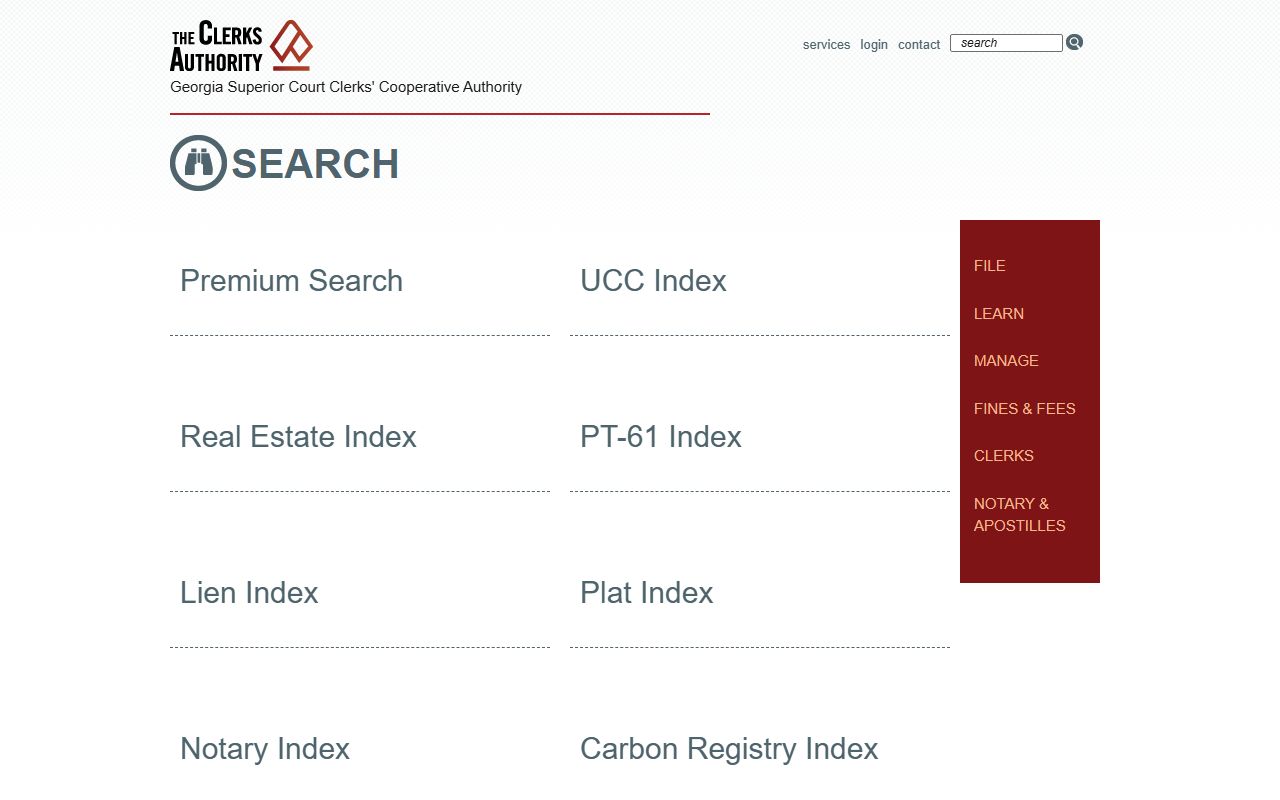
Use that statewide clerk route only for the categories GSCCCA supports; local case files and certified court copies still depend on the correct Walker County court office.
Types of Walker County Court Records
Walker County court records include several record families, and each family has its own custodian. Civil records may appear in Superior Court, State Court, or Magistrate Court depending on the subject and amount. Magistrate Court handles civil claims up to $15,000 when exclusive jurisdiction is not in Superior Court, plus garnishment, attachment, dispossessory proceedings, and distress warrants. Criminal case files may include arrest warrants, accusations or indictments, arraignment entries, plea documents, motions, orders, bonds, dispositions, sentences, probation conditions, and appeal notices.
Family, probate, traffic, warrant, and custody records need separate routing. Divorce case files and decrees are with the Clerk of Courts, not Probate Court. Probate Court handles wills, estates, guardianships, conservatorships, and marriage records. Traffic citations may involve State Court or a municipal court, while the sheriff's traffic and misdemeanor bond schedule is not the same thing as a final court disposition. Current jail custody is handled through the sheriff's phone-based AIS, not a public county roster page.
- Civil records: complaints, answers, service papers, motions, hearing notices, judgments, garnishment papers, writs, and satisfaction entries.
- Criminal records: charges, arraignment records, plea papers, motions, bond entries, disposition, sentence, and probation conditions.
- Probate records: estate petitions, will records, fiduciary appointments, notices, inventories, orders, and final discharge entries.
- Family records: divorce complaints, answers, temporary orders, custody or support documents, settlement agreements, and final decrees.
- Restricted records: juvenile, adoption, sealed criminal history, mental health, and files with protected personal identifiers.
The GSCCCA filing services page is part of the clerk-related image set for this project.
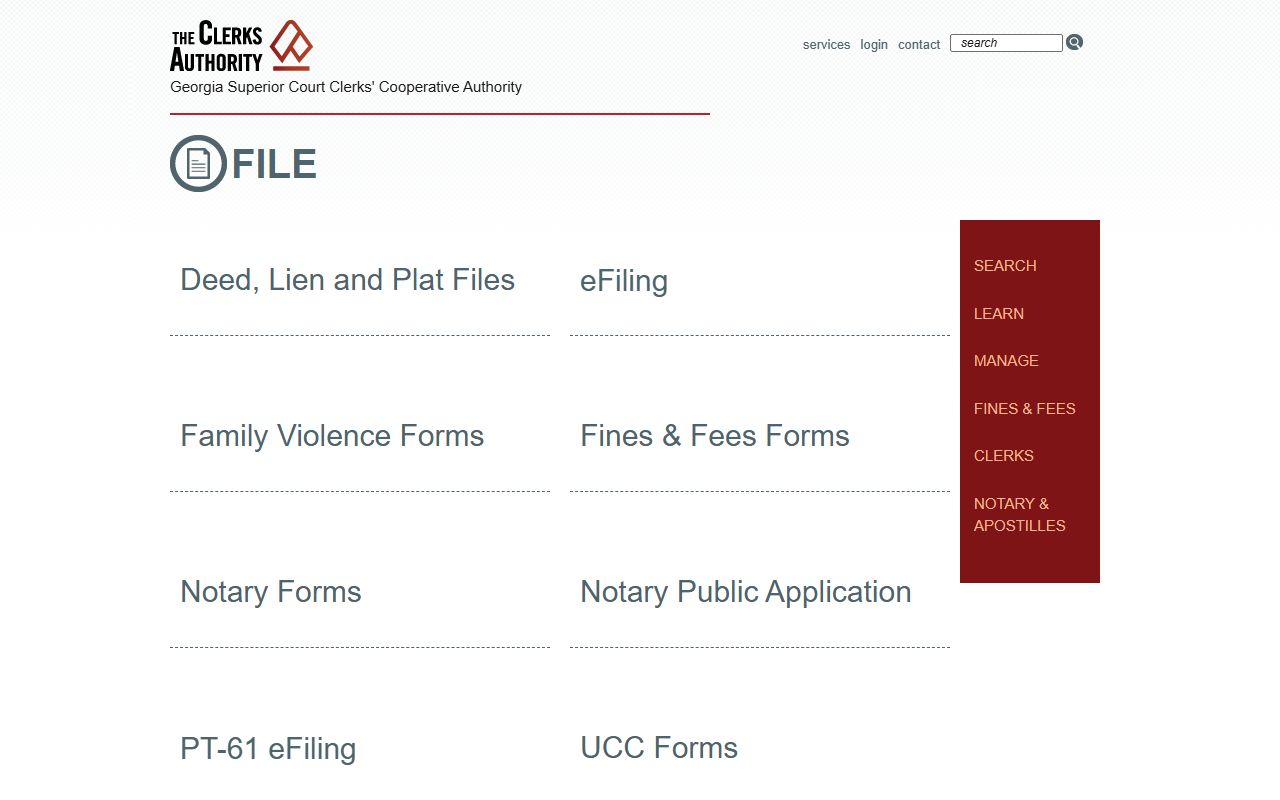
Filing services and search services should be read as separate tasks: one concerns submitting records, while the other concerns finding or requesting existing records.
What Walker County Court Records Show
A Walker County court record usually combines identity, court, event, and result fields. The research found an observed Superior Court calendar case number format such as 2024-SU-CV-452-BMH, but it does not provide a full official code key. Case records may show parties, court and judge, filing dates, hearing dates, docket entries, financial data, bonds, fines, court costs, restitution, and copy fees. Public files should not expose Social Security numbers, financial account numbers, protected minor details, confidential health information, or sealed matters.
| Field | What It Shows |
|---|---|
| Case Number | The court's assigned identifier, such as the observed Superior Court calendar style with year, court abbreviation, case category, sequence, and judge or assignment suffix. |
| Parties | Plaintiff and defendant, petitioner and respondent, State of Georgia and defendant, or probate parties such as decedent, executor, guardian, ward, heirs, or interested parties. |
| Court and Judge | The court level and judicial officer, such as Superior Court, State Court, Probate Court, or Magistrate Court. |
| Dates | Filed date, issue date, hearing date, arraignment date, recorded date, marriage date, deceased date, or will created date depending on record type. |
| Docket Entries | Arraignment, first appearance, bond hearing, motion, order, notice, continuance, plea, sentencing, civil hearing, garnishment filing, or dispossessory event. |
| Disposition | The outcome, such as judgment, dismissal, plea, verdict, sentence, discharge, or other case-ending entry. |
Public Access for Walker County Court Records
Georgia law favors public access, but the right source still matters. The Georgia Attorney General's open government law page links the Open Records Act and Open Meetings Act. The Attorney General's Open Records Act publication includes O.C.G.A. 50-18-70, which states the general policy of public access, O.C.G.A. 50-18-71, which covers inspection, copying, request procedures, and lawful fees, and O.C.G.A. 50-18-72, which covers exemptions. Court files also operate under court rules, including Uniform Superior Court Rule 21 on limitation of access to court files.
In practical terms, Superior, State, and Juvenile court records route through the Clerk of Superior Court. Marriage and probate records route through Probate Court. Warrant and first-appearance information often starts in Magistrate Court or the Sheriff's Office. Current custody starts with the sheriff's AIS phone system. If a record is not online, the public fallback is the correct office counter or NextRequest when the record is a county agency record rather than a court case file.
Note: Open access does not remove court limits on sealed files, juvenile records, mental health matters, or protected identifiers.
The Georgia Attorney General open government law page is included in the Walker County court records source images.
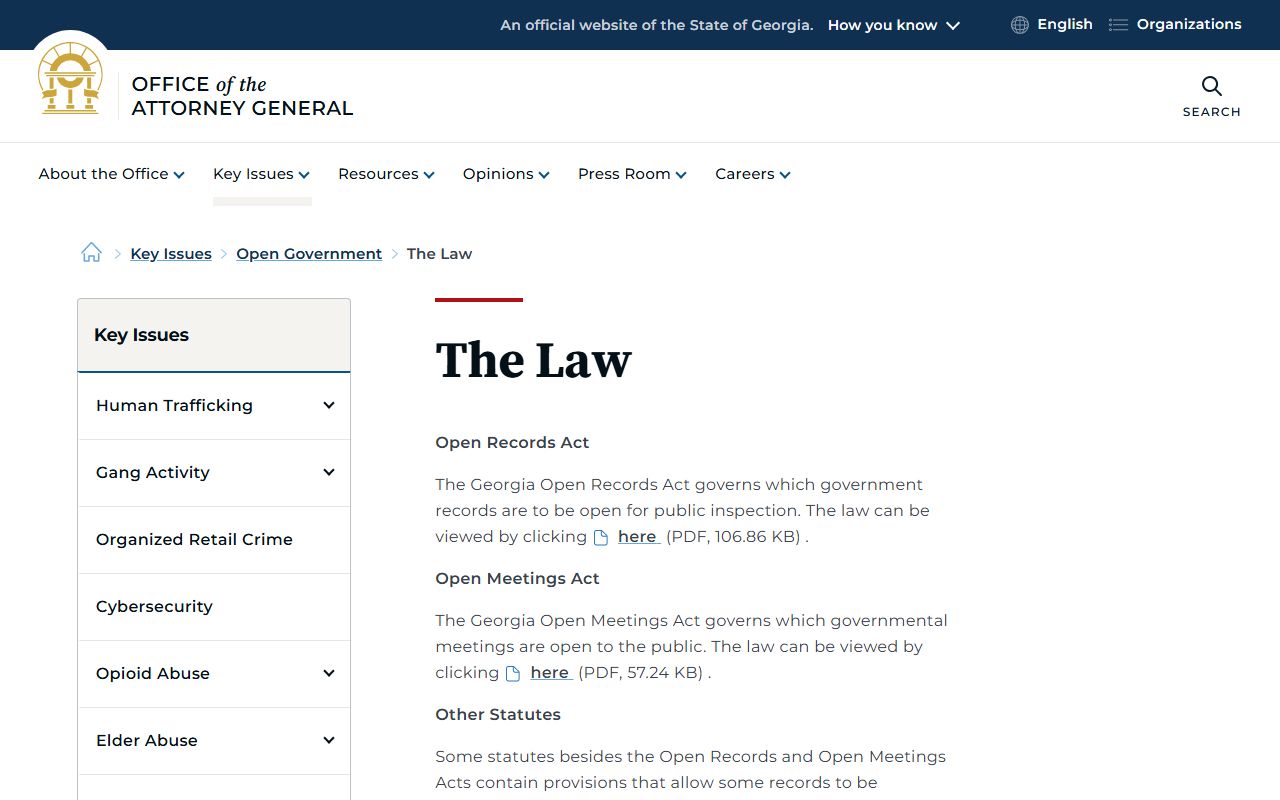
That source supports the access-law discussion, while local custody and copy questions still return to the Walker County court or agency that holds the file.
Restricted Walker County Court Records
Not all Walker County court records are public in the same way. Juvenile delinquency and dependency records are not ordinary adult files. Adoption records are confidential. Mental health proceedings handled by Probate Court should not be described as open public files. Criminal history restriction under O.C.G.A. 35-3-37 may limit access for non-criminal-justice purposes when approved. Uniform Superior Court Rule 21 also supports limitation of access to court files when law or court procedure requires it.
For post-July 1, 2013 arrests, the GBI record-restriction guidance says there is no older application process and the person must contact the prosecutor. In Walker County felony matters, that usually means the Lookout Mountain Judicial Circuit District Attorney. For State Court misdemeanors, the solicitor may be involved. For pre-July 1, 2013 arrests, the GBI instructions use an arresting-agency request process. Record restriction is not the same as destroying every court or agency record.
In-Person Court Record Requests
The Clerk of Superior Court is the main records counter for Superior, State, and Juvenile court records. GSCCCA identifies Carter Brown as Walker County Clerk of Superior Court and lists the Clerk office at the courthouse in LaFayette. Probate Court has its own Room 101 contact for probate and marriage records. Magistrate Court is nearby on South Duke Street, but not at the same counter, and it is central for warrants, first appearances, bail, dispossessory cases, garnishments, and small civil claims.
Clerk of Superior Court
103 South Duke Street, P.O. Box 1125
LaFayette, GA 30728
706-638-1742
9:00 a.m.-5:00 p.m. Monday-Friday
Walker County Magistrate Court
201 S Duke Street
LaFayette, GA
706-638-1217
Email: c.hollingsworth@walkerga.us
The manifest also assigns a CourtListener source image to Walker County court records.
Federal and local files are separate, so Walker County case searches should not be confused with Northern District of Georgia federal court lookups.