
Walker County Criminal Court Records
A criminal court record is the case-level file kept once the criminal matter reaches court. In Walker County, felony criminal matters belong to Superior Court, and State Court is important for many misdemeanor and traffic or citation matters. Magistrate Court appears early in many criminal matters because its jurisdiction includes arrest and search warrants, first-appearance hearings, preliminary or committal hearings, and bail where bail is not exclusively committed elsewhere. The complete criminal file may include arrest warrant material, an accusation or indictment, accusation amendments, arraignment calendar entries, plea documents, motions, orders, bond entries, disposition, sentence, probation conditions, and appeal notices.
Walker County belongs to the Lookout Mountain Judicial Circuit, which covers Catoosa, Chattooga, Dade, and Walker Counties. The LMJC Walker County page links Superior Court, State Court, Juvenile Court, calendars, local rules, standing orders, PeachCourt login, the district attorney, public defender, Drug Court, Wellness Court, and clerk resources. For the narrower charge list and arrest-to-charge path, use the Walker County arrest records and court charges page. For all local case types, use the broader court-record routing on the court records page.
Search Walker County Criminal Court Records
Walker County does not have one public county-branded criminal case portal covering all courts. The practical route is to start with the court level. The LMJC Walker County hub provides Superior Court, State Court, calendars, local rules, standing orders, DA, public defender, Drug Court, and Wellness Court links. The Georgia Courts e-access page is the statewide starting point, but it states that users are redirected to a provider website and must have an account to search court records.
- Identify whether the matter is felony, misdemeanor, traffic-related criminal, warrant, probation, or municipal.
- Use LMJC Walker County resources for Superior Court, State Court, calendars, arraignment, standing-order, DA, and public defender links.
- Use Georgia Courts e-access as the statewide account-based starting point when an online provider search is available.
- Contact the Clerk of Superior Court for Superior, State, and Juvenile court records that require clerk assistance or certified copies.
- For warrant, first appearance, bond, or early custody questions, contact Magistrate Court or the Sheriff's Office depending on the issue.
State criminal history is separate from a Walker County criminal court record. The GBI criminal history FAQ and record-restriction sources address statewide criminal history and access limits. A court case file may show more procedural detail than a criminal history report, while a statewide history may aggregate arrests and dispositions in a different format.
Walker County Criminal Case Flow
Criminal records change as a case moves. An arrest or warrant may happen before the full case file is complete. Formal charges then enter the court record through an accusation, indictment, or other charging document. Arraignment addresses the charges. Pretrial entries can include motions, orders, notices, continuances, bond activity, and plea discussions. A case then ends through dismissal, plea, trial verdict, sentence, probation order, or appeal activity.
Case flow: Charges Filed › Arraignment › Pretrial / Motions › Plea or Trial › Disposition › Sentencing
| Stage | What Happens |
|---|---|
| Charges Filed | The prosecutor files or presents the charge, or a grand jury returns an indictment in felony matters. |
| Arraignment | The charges are addressed and the plea posture begins to appear in the court record. |
| Pretrial / Motions | Parties file motions, orders are entered, notices issue, bond may change, and hearings may be continued. |
| Plea or Trial | The case resolves by plea, trial verdict, dismissal, or another disposition entered in the file. |
| Sentencing | The record may show punishment, probation, restitution, court costs, conditions, and revocation activity. |
What Walker Criminal Records Show
Walker County criminal court records can show identity, charge, docket, hearing, outcome, and sentence details. The research identifies criminal-case fields such as State of Georgia and defendant, court and judge, filed date, issue date, hearing date, arraignment date, docket entries, bond amount, fine amount, restitution, probation fees, disposition, and sentence. Sheriff's bond schedule entries show charge-level bond information, not necessarily a final court fine or conviction.
| Field | What It Shows |
|---|---|
| Case Number | The court's criminal case identifier, which may appear on LMJC calendars, docket entries, and clerk records. |
| Defendant | The person charged, commonly listed against the State of Georgia in criminal cases. |
| Charges | The filed offense or offenses, often tied to an O.C.G.A. section, accusation, indictment, or amendment. |
| Arraignment | The hearing where charges are addressed and the plea posture begins. |
| Motions and Orders | Written requests to the judge and the judge's written decisions or instructions. |
| Disposition | The case outcome, such as guilty plea, trial verdict, dismissal, nolo plea, or other final result. |
| Sentence | Punishment, probation, restitution, costs, conditions, or revocation-related terms after conviction. |
Walker Charges vs Convictions
A charge is not a conviction. A Walker County criminal court record may show charges that were filed and later reduced, amended, dismissed, dropped, or resolved by acquittal. A conviction appears only after a guilty plea, nolo plea accepted by the court, or verdict that results in a judgment of guilt. The difference matters for employment, housing, licensing, custody, and criminal-history review because a charge line alone does not prove the final outcome.
| Point | Charge | Conviction |
|---|---|---|
| Meaning | An accusation that an offense was committed. | A court outcome based on plea or verdict. |
| Timing | Appears early in the case or after amendment. | Appears at disposition or sentencing. |
| Record Risk | May remain visible even if later dismissed unless restricted or sealed. | May trigger sentence, probation, fines, and reporting consequences. |
| Best Source | Charging document and docket. | Disposition, judgment, and sentence entries. |
Read Dispositions and Sentences
Disposition means case outcome. In criminal records, it may appear as guilty, not guilty, dismissed, nolo, or another court-specific outcome. Sentence means punishment or conditions after conviction. It can include jail, probation, restitution, court costs, fine amount, supervision, treatment, or other terms. Probation revocation is a later proceeding for an alleged violation of probation conditions, and it can create new docket entries in the same criminal record family.
The Lookout Mountain Judicial Circuit District Attorney site is assigned in the criminal records image set.

The District Attorney is central for felony prosecution in the circuit, while State Court misdemeanors involve the solicitor listed on the Walker State Court page.
Sealed vs Expunged Records
Georgia official sources use record restriction language, and the research warns against promising expungement in the destruction sense. In Walker County criminal records, the practical comparison is sealed court-file access versus Georgia criminal-history record restriction. GBI explains that O.C.G.A. 35-3-37 provides for restriction of certain criminal history records for non-criminal-justice purposes when approved. For arrests after July 1, 2013, GBI says there is no application process through the older form and the person must contact the prosecutor. For arrests before that date, the applicant must apply for restriction at the arresting agency.
| Point | Sealed Court File | Expunged / Restricted in Georgia |
|---|---|---|
| Main Effect | Limits ordinary public access to a court file by law or court procedure. | Georgia sources describe this as record restriction, not guaranteed destruction of every record. |
| Source | May require a court petition and order. | Uses O.C.G.A. 35-3-37 and GBI or prosecutor process depending on date. |
| Record Status | The file is not treated as a routine public file. | The record is not necessarily destroyed. |
| Walker Route | Ask the court that holds the file. | Post-July 1, 2013 matters usually start with the prosecutor; older arrests start with the arresting agency. |
The GBI record restriction overview is one of the assigned criminal court records sources.
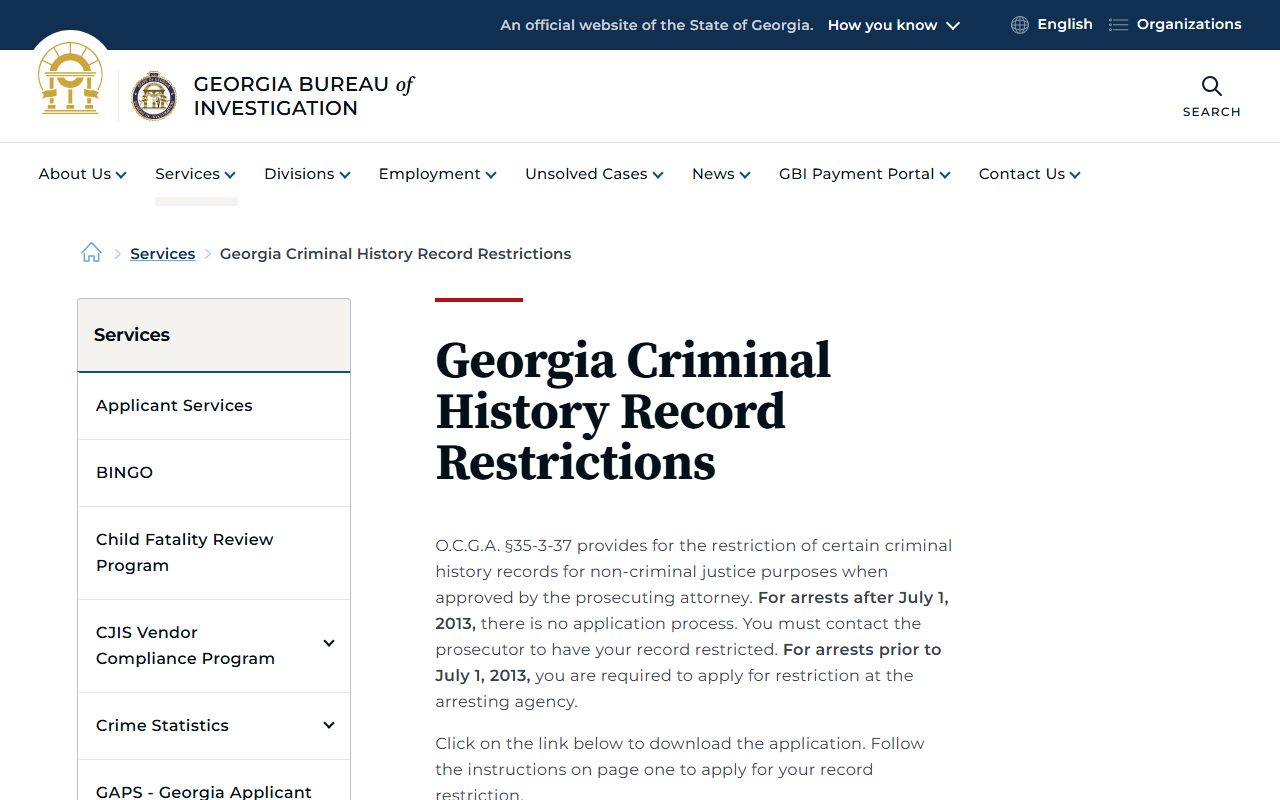
That source is the controlling research basis for the restriction process described here.
Public Access to Walker Criminal Records
Criminal court records are generally public when no law, court rule, seal, or restriction applies. Georgia's Open Records Act favors access to public records, while O.C.G.A. 50-18-72 allows exemptions. Uniform Superior Court Rule 21 governs limitation of access to court files. For Walker County, the access summary is custodian-based: Superior, State, and Juvenile records route through the Clerk of Superior Court; warrant and first-appearance information often starts with Magistrate Court or the Sheriff's Office; current custody starts with the sheriff's AIS phone system.
The GBI criminal history FAQ is assigned to the criminal court records source images.
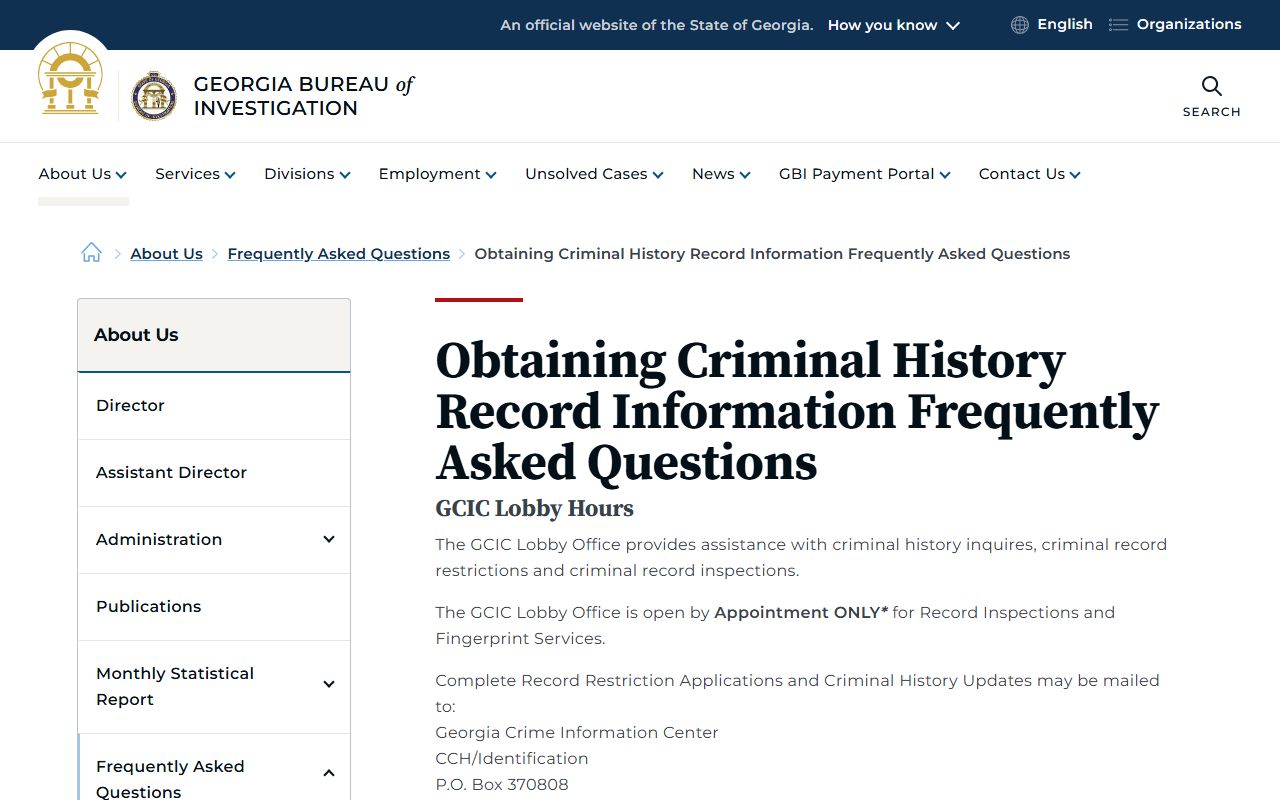
Use the FAQ for statewide criminal-history questions, but verify Walker County case outcomes with the court that entered the disposition.
Restricted Walker Criminal Court Records
Juvenile cases, sealed cases, adoption-related records, mental health proceedings, protected victim or witness information, Social Security numbers, financial account numbers, protected health information, and minor identifying information are not ordinary public court records. A public docket can also be less complete than the clerk's file. If a record is sealed or restricted, access may belong only to parties, attorneys, agencies, or persons authorized by law or court order.
Important: Criminal-history restriction does not prove that every court, law-enforcement, or agency record has been destroyed.